Where fragrance shifts with time, surface, and unseen chemistry.
By Kegomoditswe Mosime Published: 1 April 2026
You walk into your bedroom. A scent wafts through the air, familiar but not quite. You pause. You glance around, then you notice it. The scarf you wore last week, still draped over the chair. You pick it up and breathe it in. And there it is. Your perfume
But somehow it smells better than when you first sprayed it.
Whispers in Motion;
Perfume is always in motion: unfolding on skin, completing itself in fabric, and settling into a softer, more enduring scent.
Does Your Perfume Disappear?
We often treat perfume as if it behaves like a fixed object, something that either stays or fades. But perfume is not static. The moment you press the nozzle, the fragrance explodes outward in a fine mist of microscopic droplets. Thousands of fragrance molecules disperse into the air, drifting in different directions before settling on the surfaces around you. As they settle, some molecules land on warm skin, others settle into fabric fibres, and some evaporate into the air almost immediately.
At a molecular level, fragrance doesn’t simply evaporate. It transforms. And the surface it lands on doesn’t just hold the fragrance passively. It interacts, reshaping how it smells, how long it lasts, and what it becomes over time.
Perfume is changing in ways we don’t always understand.
DID YOU KNOW
Oxidation was first described in 1789 by Antoine Lavoisier as the combination of a substance with oxygen. While chemistry has since refined this definition, the idea still shapes how we understand the reaction today.
What is Oxidation?
Oxidation is the loss of electrons from a molecule during a chemical reaction. When molecules are exposed to air, oxygen is most likely to accept those electrons.
In perfumery, this process unfolds slowly through what chemists call autoxidation. As fragrance molecules interact with oxygen over time, they gradually transform into something new.
This happens all the time. We are just not paying enough attention. You spray a perfume tester in the store, fall in love with it, purchase it, then get home and spray it on your wrist, only to discover the scent is different from what you experienced in the store. This is autoxidation unfolding in real time. Here’s why: the tester bottle in the store has already been opened, sprayed, and exposed to air dozens of times, allowing the fragrance to change long before you ever experience it.
At the centre of this are terpene molecules like limonene and linalool that form the structural backbone of a fragrance’s character. The fragility of the molecules lies in their double bonds, which react readily with oxygen, causing them to break down and reform as new compounds such as peroxides, aldehydes, and alcohols.
It is these small, invisible shifts that gradually pull a perfume away from its original scent, softening its bright edges and pushing it toward something deeper, smoother, or altogether duller.
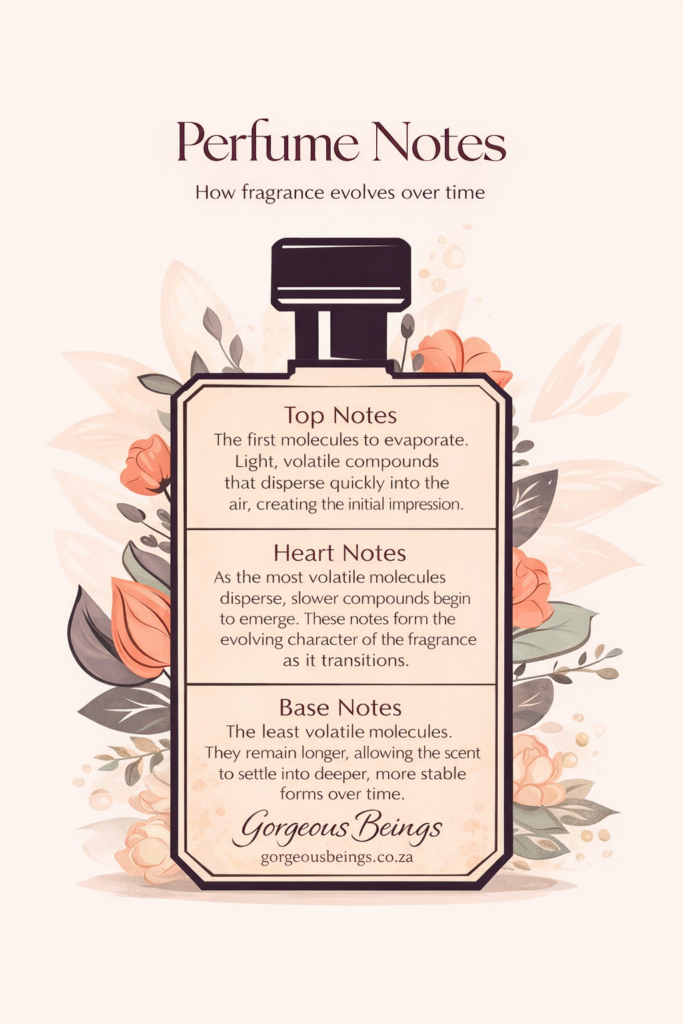
NOTES OF INSIGHTS : Top, heart, and base notes are not separate layers, but classifications of molecules based on how quickly they evaporate, dictating how a fragrance unfolds over time.
Why the Same Perfume Behaves Differently Everywhere It Lands
The reason these differences appear lies in a fundamental rule of chemistry: reactions depend not only on the molecules present, but also on how fast those molecules are allowed to react. In chemistry, this is known as reaction kinetics. A fragrance molecule exposed to heat and movement will react very differently from the same molecule sitting undisturbed in a cool fibre.
Same chemistry, different pace, different outcome.
Consider a pot of water boiling with the lid off. Heat drives everything upward and out rapidly. Place the lid on, and the same water stays contained, building and developing under its own pressure. The substance has not changed. The environment has. That is exactly what happens when perfume lands on your skin compared to on your scarf.
The chemistry does not change. The conditions do.
On Skin, the Reaction Never Settles
Skin runs warm, around 32 to 34 degrees Celsius, and that heat pushes fragrance molecules to move and evaporate quickly. As you move, the air around your skin shifts constantly, carrying scent away before it has time to settle. Add the effects of sweat, humidity, and the mild acidity of human skin, and the surface becomes one of the most disruptive environments a fragrance molecule can land on.
The most volatile molecules, meaning those that evaporate most readily, are what perfumers call top notes. These include citrus oils like bergamot and lemon, light florals, and bright aldehydes. They evaporate almost immediately after landing, escaping into the air before slower reactions like oxidation have any real opportunity to progress. Oxidation still begins on the skin, but it never gets the chance to settle.
Molecules are dissolving, evaporating, and escaping faster than any single reaction can complete itself, and the chemistry is interrupted before it can resolve into something deeper.
That is why perfume smells most intense in the first minutes after you spray it. Strong projection but little longevity is not a sign that the perfume failed, but that the surface it landed on never allowed the chemistry to run its course.
On Fabric, the Chemistry Finally Completes
When a scarf hangs in your room, it exists in what perfumers call ambient conditions, a still, controlled, undisturbed environment where temperature remains steady.
At room temperature, roughly 18 to 22 degrees Celsius, evaporation slows, and the fragrance molecules are no longer being disrupted by their environment. This controlled environment allows oxidation to unfold slowly without interruption. The surface the fragrance rests on plays a crucial role in giving oxidation time to settle.
The fabric structure bolsters this. Natural fibres like wool and cotton have porous, irregular surfaces that create small spaces which trap air and limit airflow, holding fragrance molecules in place rather than letting them escape. Molecules that would evaporate immediately from skin are held in place long enough for slower chemical reactions to continue.
Within this environment, the lighter top notes slowly evaporate, while the heavier base notes, the musks, woods, and ambers, remain anchored in the fibres where, over time, they reveal the intended full profile of the fragrance. These deeper, longer-lasting molecules are not designed to arrive quickly. They are meant to stay, to transform slowly, while shaping the fragrance’s sillage and influencing how the scent ultimately resolves itself.
For the first time since leaving the bottle, the fragrance stops performing. The sharper notes fade, and over time, the scent becomes balanced as it settles. This is not a matter of longevity, but of completion.
Fabric does not preserve the scent. It gives chemistry the time it always needed.
Pearls of knowledge; What happens on your scarf overnight is something perfumers have been deliberately engineering for decades.
Perfumers Have Always Known What Your Scarf Does by Accident
It is a known phenomenon in the fragrance industry, just rarely discussed outside it.
This is evident in how perfumers approach assessment. They rarely evaluate a freshly mixed formula immediately. Instead, they allow samples to sit, sometimes for hours, before smelling them. This kind of exposure to oxygen subtly reshapes certain molecules, softening initial harshness and allowing the fragrance structure to settle into its true form.
A formula smelled too soon is a formula misread.
This extends beyond assessment alone. Many fragrance houses deliberately age their finished formulas for days or weeks before approving them for production. This process is known as maceration. It is an essential act of maturing the blend and a deliberate choice to let the chemistry finish before the fragrance ever reaches a bottle. What you buy has already begun its chemical transformation long before you open the perfume.
Quiet Truth;
The Industry simply learned to control what your bedroom chair does by accident
Time Is the Final Ingredient
Your perfume never really leaves. It waits, not for attention, but for the right conditions to finish transforming.
If you have ever wondered why perfume lasts longer on clothes than on skin, the answer is not about the fabric. It is about the chemistry finally having room to finish.
Your skin is a performance space. Warm, moving, and volatile, it pushes a fragrance through its opening act fast and bright, then sends it off before the chemistry can settle. Fabric does something different. It holds the molecules still. It keeps the temperature steady. It does nothing, and that is exactly what the fragrance needs.
Your perfume was never meant to smell the same twice. It is a living system of molecules moving, reacting, and transforming at different speeds depending on where it lands. Time is not simply the period before a fragrance fades. It is an active ingredient, with oxygen quietly breaking bonds and forming new ones, continuously remaking what you smell. What you experience on your wrist is only part of the story. What lingers on your scarf is the rest of it.
And that quiet scent you notice the next day, faint but somehow deeper? That is not a ghost of yesterday’s perfume. It is the perfume, finally finished.
It Is Worth Something Today
Hello, Gorgeous Beings.
Have you ever experienced your perfume changing over time? Share your experience in the comments below.
👇 Scroll down for the reference list and the comments
REFERENCES
Pybus, D. and Sell, C. (2006). The Chemistry of Fragrances: From Perfumer to Consumer. Cambridge: Royal Society of Chemistry.
Sell, C. (2014). The Chemistry of Fragrances. Cambridge: Royal Society of Chemistry.
Calkin, R.R. and Jellinek, J.S. (1994). Perfumery: Practice and Principles. New York: Wiley-Interscience.
Karlberg, A.T., Bergström, M.A., Börje, A., Luthman, K. and Nilsson, J.L.G. (2008) ‘Autoxidation of fragrance terpenes as a cause of contact allergy’, Contact Dermatitis.
Matura, M., Goossens, A., Bordalo, O., Garcia-Bravo, B., Magnusson, K., Wrangsjö, K. and Karlberg, A.T. (2005) ‘Selected oxidized fragrance terpenes are common contact allergens’, Contact Dermatitis.
Limonene and linalool oxidation studies (2019) PubMed Central (PMC).
Rodrigues, A.E., Teixeira, M.A. and co-authors (2009) ‘Diffusion and performance of fragranced products: Prediction and validation’, AIChE Journal.
Chiu, Y.C., Dauskardt, R.H. and co-authors (2009) ‘Kinetics of the evaporation of fragrance compounds from cotton fabrics’, Journal of Colloid and Interface Science.
International Fragrance Association (IFRA) (n.d.) Oxidation and ingredient stability guidelines.
Mookerjee, B.D., Patel, S. and co-authors (1997) ‘Aura of Aroma: A novel technology to study fragrance emission from skin’, ACS Symposium Series.
Studies on fragrance retention in textile fibres (Textile Research Journal; Journal of the Textile Institute).


Leave a Reply